
If you’ve been exploring custom home building in Central Texas, you’ve probably come across the term “net zero”. But what does it actually mean to live in a net zero home, and is it achievable without sacrificing the luxury and comfort you’re looking for?
The short answer: yes. And more Austin-area families than ever are discovering that a net zero home is an upgrade, not a compromise.
This guide breaks down exactly what net zero means, how it works in practice, and why it’s become the gold standard for forward-thinking custom home buyers across Austin, the Texas Hill Country, and beyond.
What Does “Net Zero” Mean?
A net zero home (also called a zero energy home or ZEH) is a home that produces as much energy as it consumes over the course of a year. The result: a net energy bill of approximately zero.
This is achieved through two strategies working together:
Dramatically reducing how much energy the home needs through green design practices, a tight building envelope, superior insulation, high-performance windows, and smart HVAC design.
Generating clean energy on-site, typically through rooftop solar panels, often paired with battery storage.
When these two strategies are well-matched to a home’s size and the local climate, the utility meter essentially runs backward as often as it runs forward, producing a net energy balance near zero at the end of the year.
Net Zero vs. Net Zero Ready vs. LEED vs. Energy Star: What’s the Difference?
These terms are related but distinct, and understanding them helps you make a more informed decision when building a custom home.
| Term | What It Means |
| Net Zero | The home produces as much energy as it consumes annually |
| Net Zero Ready | The home is built to be highly efficient and solar-ready, but panels haven’t been installed yet |
| LEED Certified | A points-based green building certification covering energy, water, materials, and indoor quality |
| ENERGY STAR | An EPA program certifying homes that are at least 10–20% more efficient than code |
| HERS Index | A numerical score measuring home energy efficiency |
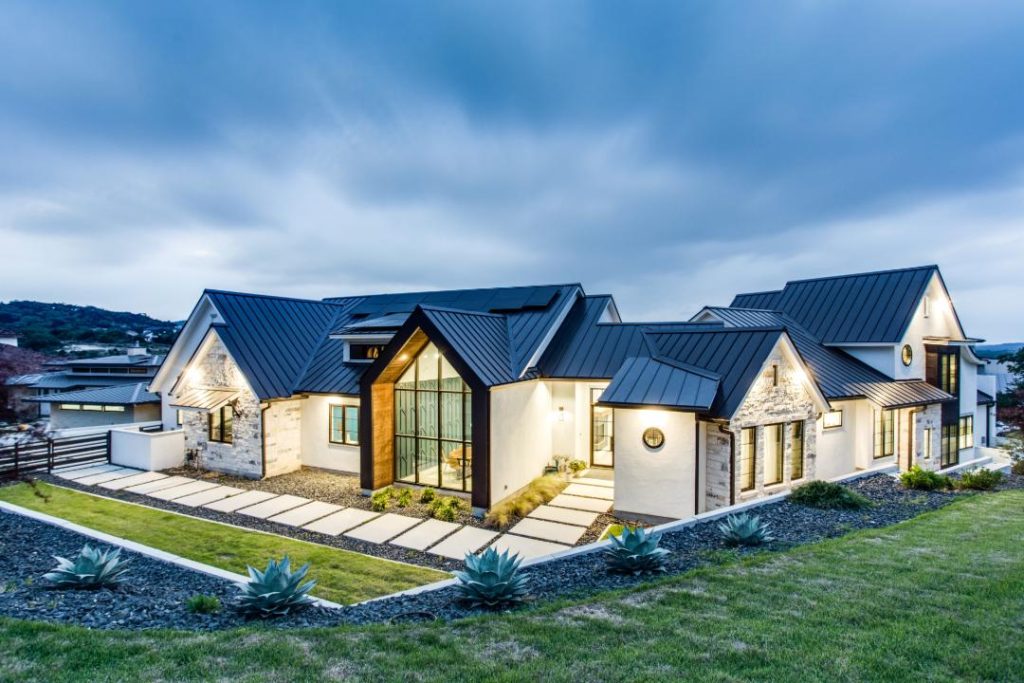
A true net zero home typically achieves a HERS score near zero and often qualifies for ENERGY STAR certification as well. At Build Native, our homes are designed from the ground up to reach net zero performance, not as an afterthought, but as a core part of the design process.
How Is a Net Zero Home Built? The Key Systems
Rather than resulting from a single product or feature, reaching net zero depends on several interconnected systems all working together. Here’s how Build Native approaches each one.
Building Envelope
The building envelope is the physical barrier between the conditioned interior of your home and the outdoor environment: the walls, roof, foundation, windows, and doors. A tight, well-insulated envelope is the single most important factor in a net zero home.
Build Native uses advanced framing techniques and insulated concrete forms (ICF) to minimize thermal bridging and air leakage. The tighter the envelope, the less energy your HVAC system needs to maintain comfortable indoor temperatures, and the smaller (and cheaper) that HVAC system can be.
Insulation
In Central Texas, your home must be ready to defend against both intense summer heat and short but freezing winters. Standard fiberglass batts simply don’t cut it for a high-performance home.
Build Native primarily uses open-cell spray foam insulation as the primary method of achieving a high-performance thermal building envelope. Spray foam is the most cost-effective insulating material for residential use: it seals your home from air and moisture intrusion, reduces pest infestations, protects against airborne pollutants and allergens, and reduces HVAC sizing requirements and maintenance over time. Build Native also offers an option for continuous insulation on the exterior of our homes, a method that is gaining popularity and has become increasingly common with passive homes.
Energy-Efficient Windows
Windows are one of the biggest sources of heat gain and loss in any home, especially in Texas. Build Native specifies double-glazed, low-emissivity windows that minimize heat transfer and maintain comfortable indoor temperatures year-round.
These windows reduce the load on your HVAC system, lower utility costs, and meaningfully shrink your home’s carbon footprint without compromising on views or natural light.
High-Efficiency HVAC
Traditional gas furnaces and older air conditioning systems are significant energy consumers. Build Native’s approach prioritizes air source heat pumps as the HVAC backbone of a net zero home.
These systems operate the same as your refrigerator (which is also a heat pump). They essentially pump heat from one area (the house) into another (outside). In the winter time, they work in reverse. In moderate climates like Texas, a high-efficiency heat pump can reduce heating and cooling energy consumption by 30–40% compared to traditional systems.
For properties where it makes sense, Build Native also offers geothermal heat pumps, which tap into the earth’s stable underground temperature (approximately 70°F year-round just six feet below the surface in Texas) for even greater efficiency.
Solar Power & Battery Storage
After reducing energy demand through the strategies above, the final step is generating clean energy on-site. Nearly all Build Native custom homes include solar power as part of the net zero equation.
Solar panel costs have dropped dramatically over the past decade, making solar the most cost-effective path to eliminating your electric bill. Build Native also integrates battery storage systems, meaning your home stays powered even when the Texas grid is interrupted, a real concern for Central Texas residents after recent grid events.
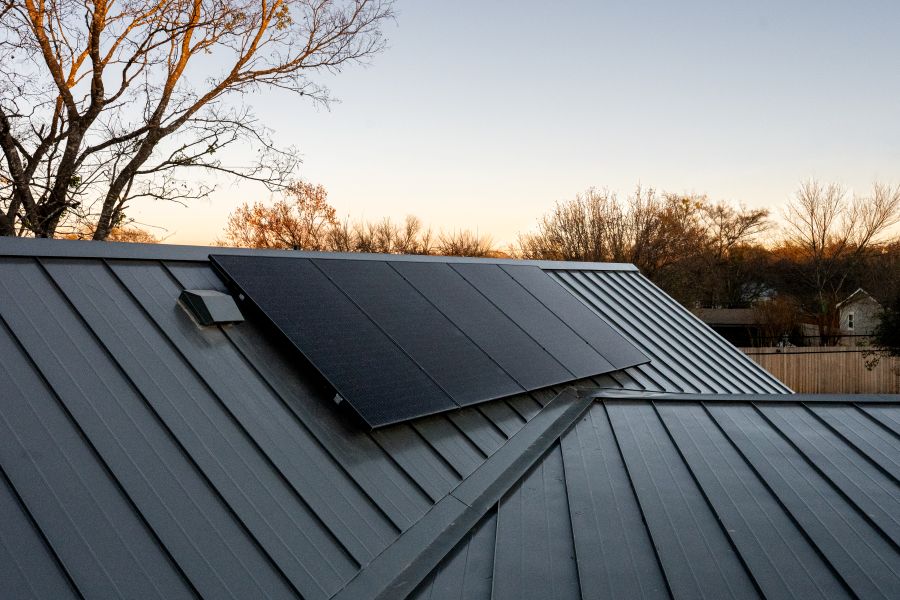
When designing your home, Build Native ensures adequate roof space in the correct orientation for maximum solar production. Standing seam metal roofs, a Build Native signature, are particularly well-suited for solar installation, as panels can be mounted without making any penetrations in the roof.
Rainwater Collection
In much of Central Texas and the Hill Country, municipal water access is limited or expensive. Build Native incorporates rainwater harvesting systems that capture, filter, and store rainwater as a primary potable water supply.
The majority of Build Native homes with rainwater systems supply 100% of the home’s water demand from harvested rainwater. After passing through filtration and purification, rainwater is typically higher quality than municipal or well water.
For homeowners interested in true sustainability, this means achieving net zero on both energy and water.
Why Build a Net Zero Home in Central Texas?
The case for net zero is strong everywhere, but it’s especially compelling in Austin and the surrounding region.
Texas electricity costs are unpredictable. Wholesale energy prices in Texas are among the most volatile in the country. A net zero home with battery backup insulates you from price spikes and grid outages.
The Texas climate is demanding. Long, intense summers put enormous strain on standard homes. A well-designed net zero home handles the heat more comfortably and at far lower operating cost.
Resale value is increasing. Buyers are increasingly sophisticated about energy performance. A certified net zero or near-net zero home commands premium resale value and sells faster than standard construction.
Incentives are available. Federal tax credits for solar installation and battery storage significantly reduce the upfront cost of net zero systems. Build Native can help you navigate available incentives as part of the design process.
It’s better for the Hill Country. Water scarcity and environmental sensitivity are defining characteristics of the Texas Hill Country. Building sustainably isn’t just a financial decision, it’s a stewardship decision for one of the most beautiful landscapes in the country.
What Does a Net Zero Home Cost to Build?
Net zero homes typically carry a modest premium over code-minimum construction, primarily due to higher-performance insulation, windows, mechanical systems, and solar. However, this premium must be viewed against:
- Lower monthly operating costs – many Build Native homeowners have electric bills near zero
- Reduced HVAC maintenance and replacement costs over the home’s life
- Energy price insulation – you’re protected from future utility rate increases
- Higher resale value in an increasingly energy-conscious market
- Federal and state incentives that offset upfront costs
The total cost of ownership for a net zero home is lower than a conventionally built home of comparable size and quality.
Build Native has been building green in Austin and Central Texas since 2007. We offer transparent design-to-build pricing and work closely with you to optimize the balance between upfront investment and long-term performance. Ready to learn more about our homes and take your first step on the journey towards a truly net-zero custom home? Reach out to team today to start the conversation.
